
Best Advice For Hiring Maids For Expats (in Singapore)

Why Most Expats Fail Their First Hire (And How to Be the 1% Who Doesn't)
If you have never had a maid before, then it can be quite difficult knowing how to avoid a nightmare and get a good maid. Most people will tell you "Just go with your gut."
That's probably the worst advice ever!
Instead of telling you to rely on your gut, I'm going to give you my fool-proof system of hiring. I wrote this guide for first-timers, without any previous maid hiring experience. Let's dive deeper into the things no one tells you about!
"I kept smelling this faint, stale scent in the baby's room but I just couldn't put my finger on it. Then, I found a crushed cigarette butt hidden in a potted plant on the balcony, literally five feet from where my toddler naps. When I confronted her, she was so confused—she said she ‘only had one’ to relax while the baby slept and thought as long as she was ‘outside’ it was fine. She didn't get the second-hand smoke thing at all. It was a total values heart-stop for me. It’s one of those 'dealbreakers' you assume everyone just knows, but in this gamble, you can’t assume anything."
- Lalia
Table of Contents
- Background Information
- Before Interviewing Candidates
- Things To Consider When Finding a Candidate
- How To Conduct An Interview
- Why You Should Not Treat Your Maid Badly
- Why You Should Not Treat Your Maid Too Well
- What a Maid Hiring Agency Does For You
- How to Hire Transfer Maids
- Screening for Previous Work Experience What Maids are Looking For
- How to Conduct Orientation
Background Information
The average wage of a live-in maid in Singapore is between $650/month - $1,000/month.
Some extra costs to consider are:
- Government levy of $300/month
- Living expenses around $200/month
- Food expenses around $500/month
- Health Insurance around $100/month
- Travel expenses around $50/month
Popular countries are:
- Philippines
- Myanmar
- Indonesia
- India
- Malaysia

Before Interviewing Candidates
First, get clear on what you want and what you need, they are equally important.
What you want: you have to make sure you get your personal preferences straight, so that you do not work with someone that doesn’t fit your lifestyle or personal preferences (e.g. these are all the subjective judgements that you give someone, their look, the sound of their voice, their personality, the way they walk etc.)
What you need: these are the non-negotiables by which you will measure an applicant’s strengths, based on the needs of your household. An applicant is qualified for an interview based on passing these requirements (e.g. diet preferences, their age, the job description, specific skills needed, language spoken etc.)
*Tip* For families with young children, it is better to find someone between 30 - 40 years old.
"I walked into the kitchen and found my three-year-old sitting in front of a YouTube marathon, eating a bowl of white rice drenched in condensed milk.
My helper looked so proud of herself and said, ‘See, Ma’am, he’s so quiet and happy for me!’
I’d spent two years on a no-sugar, no-screen rule, and she was undoing it all in one afternoon because in her culture, a ‘happy’ kid is a quiet, fed kid. She wasn't being lazy; she genuinely thought she was doing a great job. That’s when it hit me—if you don't vet for parenting alignment, you’re just paying someone to raise your kids with a completely different set of values."
- Fernando
Most companies have a ‘no discrimination’ policy, to promote fairness in hiring decisions and diversity in the workplace, minimising the impact subjective preferences have on the hiring process. However, when it comes to domestic help, it is okay to be as ‘subjective’ as you want. After all, they will be living with you for a long time (hopefully).
With that being said, at any point, if the fit is not good, don’t be afraid to find someone new straight away. This is not a time to worry about the sunk cost, at the cost of future worry and discomfort.
When considering ‘what you need’, it is important to come up with a list of things you will require your maid to do on a regular basis. For things that do not need to be completed on a regular basis, that you still have requirements for, try to separate them out and de-prioritise them when searching for domestic help.
For example, if you need the maid to regularly cook, and only occasionally make dessert, then you would prioritise finding someone good at making lunch and dinner, rather than dessert.
This process helps you to clarify what are the top qualities you are looking for, compared to the other ‘nice to have’ qualities. These top qualities will need to be part of the maid’s personality from the beginning. Assuming that people won’t change, you will need to look for someone who is already ‘caring’, rather than hoping to develop them into a ‘caring person’ over time.
Here are some of the things I decided to look for:
- Honest and simple (does not think of playing mind games or hold a grudge, or try to overstep boundaries)
- Have a pleasant disposition (caring and gentle; warm to children)
- Positive person (usually happy and looks for the positive side of things; knows how to have a good laugh)
- Obedient (happy to follow instructions on tasks, even if it goes against her own ways)
- Comfortable with being a helper (does not lead a double life - maid life, night life, friend life, church life etc)
- Curious about new things (eager to learn the ways of the household, rather than sticking to what they know already/what they have been doing before)
- Neat and tidy (knows how to maintain a home to a high standard; requires attention to detail on a daily basis)
- Trustworthy (would not try to cheat you of food or use your bathroom in secret, would not sabotage you in secret)
- Keeps to themselves and can be eager to please their employer (have a certain degree of fear of their employer, rather than viewing them as equal to the family and entitled to certain ‘privileges’)
Notice how my requirements do not specify any hard cut offs - age, number of siblings, marriage status, number and age of children.

Things To Consider When Finding a Candidate
Depending on the background of the maid, there can be a wide range of experience levels and previous work experiences for the same price, say $700/month SGD. For this reason, it is important to do a background check, by asking them a series of questions that give you hints about this person’s true motivations.
Sometimes it’s easier to list down what you would not want in a maid, so I have compiled a handy list of things that may help you:
40% of first-time hires in Singapore don't make it to the one-year mark
Not Homesick
Homesick is a very natural feeling, and all maids will feel this to some extent. What we don’t want is someone who may develop depression from this. Someone who is more prone to culture shock, someone who has young children at home (under 5 years old), and someone who doesn't have any family or connections in Singapore will more than likely become quite homesick.
Ask:
- What will you do to cope with culture shock when you get to Singapore?
- What are the ages of your children? Who usually takes care of them?
- Do you have any relatives or friends in Singapore already?
- Why do you want to work in Singapore?
Good at English
For many people, English will be how you communicate with the maid, so it is important to make that process as smooth as possible. This means that you will want to test their English skills during the interview.
The way to do this is to not intentionally slow down your speech or ‘dumb down’ your English while interviewing someone. If they can understand you, then chances are you will have an easier time communicating with them when they are actually here. Most maids have a primary level education, so their English won’t be that great. Without you and the maid being able to understand each other easily, you may end up using sign language and hand gestures in your own home (not relaxing!).
Doesn’t Lead Double Lives
I say this because a lot of people do this in secret. They act one way in front of you, and another on their day off. Perhaps you might think that this is a bit of an overstretch, but it’s better to be safe than sorry!
What we don’t want is for someone to drink and party on their days off, buy lottery tickets, or smoke when you’re not around. I’ve heard of maids who secretly use the main bathroom, who wear the employer’s clothes, and who punish the children or elderly.
Ask:
- What will you do on your days off? Where will you be spending your time?
- What are your hobbies?
- Where do you want to explore when you get to Singapore?
- Tell me about your previous work schedule
- Tell me about your previous employer
After two months, a bad hire will cost approximately $3,304 in fees, insurance, two-way airfare, and "settling-in" costs
Doesn’t Have Financial Burdens
If someone has financial burdens, then chances are, they will not tell you about it.
However, you still want to probe and dig as much as possible to uncover any unwanted nasties to prevent maids from losing all their money to a scam, having motivation to steal, or being stressed out about their finances during working hours.
Once I asked someone how much money they will be sending back home, and they said $700, out of $800/month, leaving them with $100/month to spend on themselves. I asked them why they are sending so much money back home, and that was when she told me that she needed to support her daughter’s business loan repayments – a red flag!
Ask:
- How much money will you be sending back home? (I look for people who send about 50% back to their family, and keep 50% for themselves to spend)
- How much do you want to save by the end of your 2 year employment?
- What are you saving towards? (e.g. building a house; children’s education)
Won’t Be Looking For a Boyfriend/Girlfriend
Maids come here to work, leaving their family and friends behind. I get it, it gets lonely sometimes. However, I also wouldn’t want my maid to ‘satisfy herself’ by getting frisky over the weekend. Sometimes this happens, at which point you find out that the maid is pregnant, and you have to send her back to her home country.
Ask:
- How will you stay in touch with your family while you are here?
- How often do you chat with your family/kids/husband?
- What does your husband do for work?
I talk to so many moms who are drowning in laundry and stress, but they’re too scared to hire because they heard a horror story.
Won’t Be Stealing/Finding Husbands
Some people are overly concerned about this, and some are not concerned enough about this. What we want to distinguish, is basically a maid who knows that they will eventually go back to their home country – not someone who is trying their hardest to stay in Singapore (by whichever means necessary!).
Ask:
- What is your plan for your retirement?
- At what age do you plan to retire?
- How long do you plan to work in Singapore?
Not a Job Hopper
Ideally, you will want to look for someone who has stayed for one contract renewal (that would be 4 years). Or, have at least stayed one full contract (2 years).
Read How to Hire Transfer Maids for more on this topic.
No Underlying Health Problems
In Singapore, you are the maid’s employer and therefore responsible for their health insurance and general wellbeing. Someone with underlying health problems may be tempted to come to Singapore just to receive better health care, and pass that burden on you!
We want to avoid this, so try asking:
- Have you ever had any major operations before?
- Are you currently taking any medications?
- When was the last time you visited the doctor?
- How many sick days did you take last year?
Don't settle!
Use my guide to hire the person that will make your life 10x easier

Money Back Guarantee
I’m so confident my 50-Question Interview will spot the red flags that I’ll take all the risk. If you use my system on three candidates and don't feel like you've completely removed the 'gamble' from your hire, I’ll refund you. No hard feelings. I want you to have the same peace of mind I do. If I can't give you that, I don't want your money.
How To Conduct An Interview
Once you have these qualities in mind, it is important to ask the right questions, to gauge a person’s match.
If you ask someone “Are you hardworking?”, everyone would answer “yes”, no one would say “No, I’m not hardworking”. But not everyone is hardworking, we all know people who try to appear hardworking, who are actually lazy. So when asking interview questions, it is important to listen for their tone, what they choose to say, how they say it, and what their reaction is to the question.
It is quite difficult to know if a stranger is lying or not, and whether a person is true to their words during an interview. Sometimes people oversell themselves, sometimes they undersell themselves.
One way to get better at judging candidates as a domestic helper, is to conduct more interviews, ask the same questions, and get a range of answers back. Over time, you will be able to calibrate your senses to sniff out the genuine responses from the fake ones.
A person’s upbringing, their career history, and personal life choices shape much of their personality and personal qualities. Someone who claims to be hardworking, who only chose to do ‘easy jobs’, who could not maintain a full work contract, and who could not give a straightforward example of them being hardworking, could not be expected to work hard.
On the other hand, someone who demonstrates an ability to wake up early and work for long hours, someone who maintains a long work contract with bigger households, and someone who never really took more than a month of career break, will probably maintain their work ethic once they join your family. So if this person answered “Yes, I am hardworking.”, then you know they are being congruent and telling the truth.
*Tip*
In order to gauge their cooking ability, I ask candidates to send me photos of food they have cooked before. Based on the photos, you will be able to tell:
- What kind of food they enjoy cooking (if they took a photo of it, it means they are proud of their work)
- What kind of food they enjoy eating (to make sure they can adjust well to your family’s dietary preferences)
- Whether they can handle more complicated recipes (a 3 hour dish, or a fish dish)
- Whether they can cook for a large number of people (if you frequently have guests over or host dinner parties)
- Whether they take pride in their work (is it a fuzzy photo, or is it a well presented one?)
- Whether they are lazy (do they send you the photos, or are they too lazy to even do so?)
I also ask them to walk me through the steps of cooking xyz dish, just to check that they do know how to cook it.
"I tried not to be that 'micromanaging expat,' but then I caught her scrubbing the baby’s high-chair tray with the same sponge she’d just used on the floor drains. She just looked at me blankly—it wasn't malice, it was just a massive 'common sense' gap I never vetted for..."
- Julie

Why You Should Not Treat Your Maid Badly
Just like in a company, a good employee relationship is maintained by aligning the employee’s interest with the interests of the company. If there is a mis-alignment or even a conflict of interest, you cannot expect the employee to put the interests of the company above their own. In the same way, it can be helpful to pre-think about how you can align the maid’s self interest with your interests, and the interests of the family.
Treat your domestic helper with respect and courtesy, and they will most likely do the same to you. Treat your domestic helper with rudeness and contempt, and they will probably do the same to you in their hearts. The closer this person is with your family, the more important it is to make sure your interests are aligned.

Why You Should Not Treat Your Maid Too Well
If you are someone who tends to be soft and easy-going, then you may need to adjust your style to have a certain degree of authority when communicating with the maid. Elevating the maid’s status can happen bit by bit through concessions, unconscious actions, and subtle differences in tone.
Just like raising pets or children, a leader must be someone who is dependable and firm; someone who holds a certain degree of authority as the leader of the household.
Instead of “Lilly, when can you wash the dishes today? It’s okay to wash it tomorrow if you’re too busy today.”, say “Lilly, please wash the dishes today, do not leave them until tomorrow. Make sure the kitchen is clean and tidy by the end of each work day.”
Being firm does not mean being mean or obnoxious. Being firm does not make you into a dictator or make you sound annoying. Being firm gives the maid the freedom to perform the tasks with certainty and clarity. They will know what is allowed and what is not allowed, and find their own way to work comfortably within those guidelines.
Be consistent, clear, and confident when you outline their job duties, work expectations, and work hours.
Don’t be afraid of setting a number of rules for them to follow. Setting rules early when they first arrive, allows the maid to know what you expect of them. Reasonable rules that help them do their job with clarity, will make them happy. Unreasonable expectations, or the lack of rules, will lead to confusion and chaos at home. No one knows what to do, who to listen to, and what the job expectation is.
Some people may feel bad for the helper, or feel indebted to them, or are afraid of appearing ‘bossy’ to the helper. The helper chose to do this job. They want to do this job well. If they were unhappy about their position or the job requirements, then they would not have become a maid in the first place.
You also hired this person, based on interviewing for the best person within the talent pool.
"I walked into the kitchen and found my three-year-old sitting in front of a YouTube marathon, eating a bowl of white rice drenched in condensed milk.
My helper looked so proud of herself and said, ‘See, Ma’am, he’s so quiet and happy for me!’
I’d spent two years on a no-sugar, no-screen rule, and she was undoing it all in one afternoon because in her culture, a ‘happy’ kid is a quiet, fed kid. She wasn't being lazy; she genuinely thought she was doing a great job. That’s when it hit me—if you don't vet for parenting alignment, you’re just paying someone to raise your kids with a completely different set of values."
- Fernando
What a Maid Hiring Agency Does For You
Maid hiring agencies usually source candidates from local agencies in the home country. There are usually two sources of candidates, people with ex-Hong Kong, ex-Saudi, or ex-Singapore experience, or fresh candidates who have never been overseas.
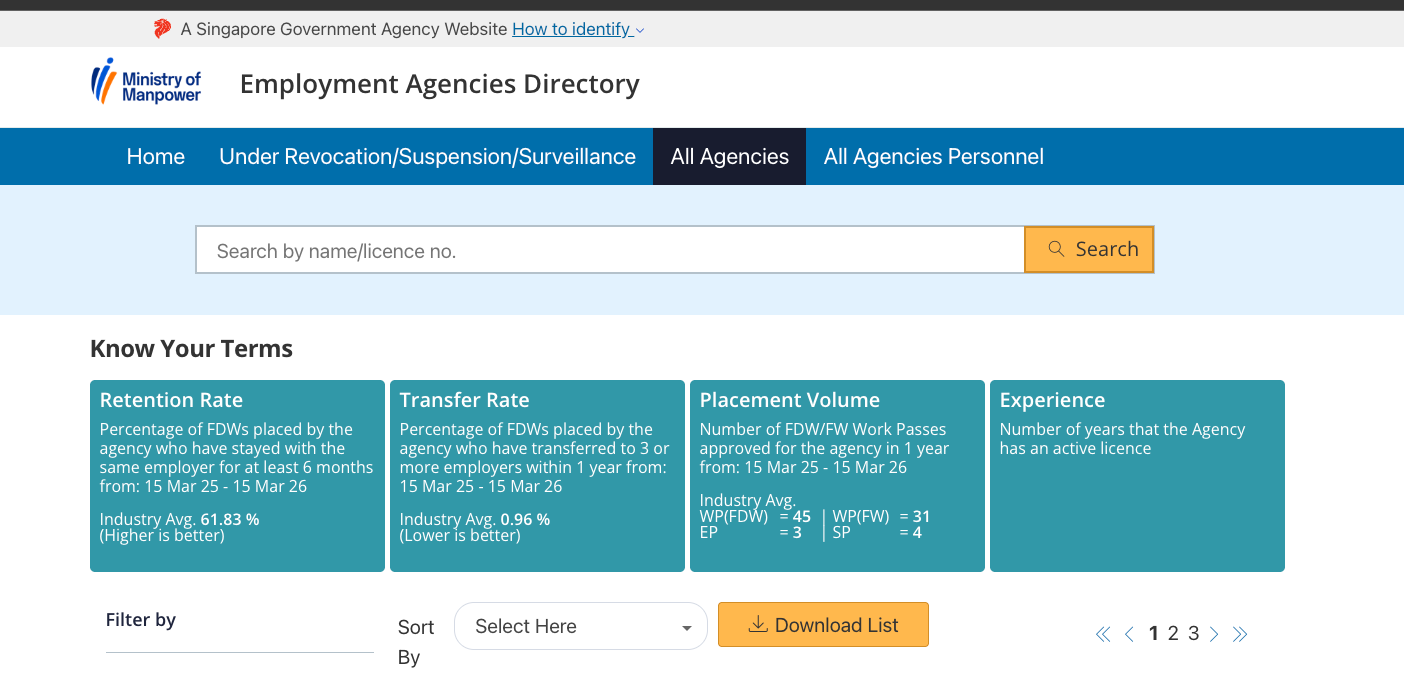
All agencies are registered with the government, and they are required to report in their “pass rate”:
1. Retention Rate
Percentage of maids placed by the agency who have stayed with the same employer for at least 6 months. Industry Avg 61.83%
2. Transfer Rate:
Percentage of maids placed by the agency who have transferred to 3 or more employers within 1 year. Industry Avg 0.95%
3. Placement Volume:
Number of maid work passes approved for the agency in 1 year. Industry Avg 45
4. Experience:
Number of years that the Agency has an active licence
Go to
https://service2.mom.gov.sg/eadirectory/#tab-1 for more information.
"I was about to just close my eyes and pick a name from an agency bio because I was so burnt out, but after talking to Kate, I finally felt like I was back in the driver's seat.
Most people out here just give you these fluffy, 'be kind' tips that don't help when you're staring at a stranger in your kitchen. It’s the only no-BS advice I’ve found in Singapore that treats your household like the business it actually is. Honestly, she saved my sanity and my bank account in one go. Best money I've spent in Singapore so far."
- Priya

Screening for Previous Work Experience
Maids who have proven themselves in “tougher” work environments are a good starting point/reference point in the talent pool.
“Tougher” work conditions include:
- Longer hours
- Little to no days off
- A bigger family
- A more rigorous daily routine
- A family with pets
- A family with multiple cars/special equipment to clean/maintain
- A family with special care members (elderly, babies, children, or disabled members)

What Maids are Looking For
Most maids, when you ask them what they are looking for, they will tell you “A good family, who will treat me well.”.
Maids are humans as well, they prefer to work for employers who are happy instead of stressed, a calm environment instead of a chaotic environment, and for families filled with love instead of filled with arguments.
Ages of Children: Some maids will be hesitant around children the ages of 10-18, because they are usually already quite set in their ways, and the maid might not be able to build a relationship with them as easily as they would with toddlers that they have cared for from a much younger age. For this reason, it is advisable to have the children or other members of the household to interact with or interview the maid as well, just to make sure they get along.
By Themselves: Some maids prefer working alone (not with other helpers), or alone (in the house by themselves during the day).
Independence: Some maids prefer to be more independent, learning new skills, and trying new things. Some prefer to always listen to you for direction, and not do anything without asking.
Something to look forward to: On the other hand, if you have young children, some maids may want to build a close relationship with them. This gives them something to look forward to, and gives them purpose when they stay with your family. Allowing your maid to have a “purpose” will give them intrinsic motivation to do their best every day.
These are all their personal preferences, and there’s always a mix, so try to find out what work style suits them and your family best.
How to Conduct Orientation
When conducting the interview, make sure your House Rules are communicated clearly with the maid, and that they are happy with the arrangement.
House Rules can be:
> What time they should return home on their off day e.g. before 9pm
> What they are allowed to wear e.g. keep your hair tied up in a neat bun/no nail polish
> If they eat together with the family or if they eat only after the family finishes eating
> What times are for TV watching/phone using
> If they are expected to feed the baby at meal times
> If they are expected to climb stairs (for multi-storied houses)
> Whether they have a separate food allowance (if they prefer to cook their own food)
Before your maid arrives, they might have come from another family, or from a few months of finding work - which means they would have been on vacation.
Don't settle!
Use my guide to hire the person that will make your life 10x easier
Money Back Guarantee
I’m so confident my 50-Question Interview will spot the red flags that I’ll take all the risk. If you use my system on three candidates and don't feel like you've completely removed the 'gamble' from your hire, I’ll refund you. No hard feelings. I want you to have the same peace of mind I do. If I can't give you that, I don't want your money.